Pengfei Han[1]
Overview
U.S. sanctions against China arise from the evolving international geopolitical landscape and are expected to persist and intensify, likely extending from military to civil and commercial technologies. It would be unrealistic to rely on changes in domestic political forces in the United States to lift such sanctions.
However, despite widespread attention and even sensationalism surrounding U.S. sanctions against China, our empirical findings show that these sanctions may not be able to precisely target their intended objectives or effectively achieve their policy goals. U.S. sanctions have not led to significant U.S.-China technology decoupling, and Chinese enterprises in sanctioned fields have demonstrated notable resilience, as evidenced by their increasingly original and explorative R&D activities, despite experiencing moderate declines in business performance.
Our empirical results show that U.S. sanctions have led to significant yet asymmetric spillover effects on both the upstream and downstream fields of the sanctioned industries in China through the innovation network.
The spillover effects of sanctions on upstream and downstream industries create an inevitable trade-off between their two policy objectives: if sanctions target relatively downstream industries, the spillover effects can lead to their upstream industries' decoupling from the international technological system, accompanied by an improvement in business performance. Conversely, sanctions targeting relatively upstream industries harm downstream enterprises' performance but accelerate their integration into the international technological system, thus failing to achieve decoupling.
As the third issue of the "U.S.-China Technology Decoupling" report series, this policy brief is structured as follows: The first section introduces the current economic sanction and technological blockade measures taken by the U.S. against China, particularly those through the "entity list." The second section evaluates the impact of the entity list sanctions on Chinese enterprises. The third section examines the spillover effects of U.S. sanctions within the innovation network framework. The fourth section offers policy recommendations based on these findings.
I. U.S. sanctions against China
In recent years, the evolving international geopolitical landscape has led to an intensification of U.S. technological blockades against China, particularly through the "entity list"—a list of entities published by the U.S. Department of Commerce that are subject to export controls. Measures such as prohibitions or restrictions on the export, re-export, or transfer of specific products or technologies are applied to the listed entities. The first "entity list" was issued by the Clinton administration in 1997, initially including only one Chinese entity, the China Academy of Engineering Physics (also known as the "Ninth Academy"). Throughout the Bush administration and the first term of the Obama administration, the number of Chinese entities and technological fields involved remained relatively low. However, in 2014, after China became the world's largest economy by purchasing power parity, the Obama administration proposed the "Pivot to Asia" strategy and began to escalate its sanctions against China during the second term. These measures escalated further during the Trump administration, leading to a significant increase in the number of Chinese entities and technological fields subject to sanctions.
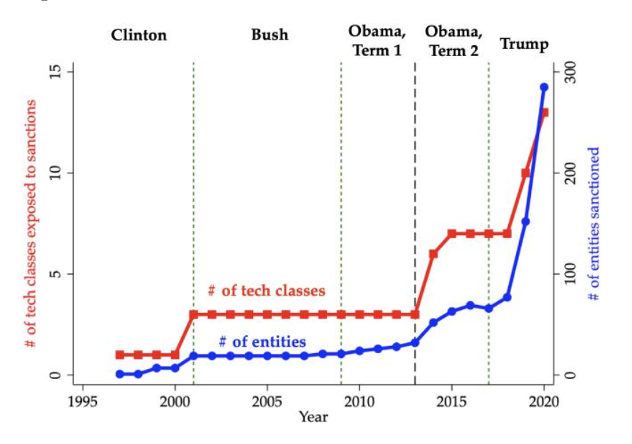
Figure 1. Number of Entities and Tech Classes Exposed to U.S. Sanctions
II. Economic Impact of U.S. Sanctions
Empirical results from this research do not find that the sanctions have led to the decoupling of the U.S. and Chinese technology systems, which, in fact, have become increasingly interconnected under the sanctions. Following China's accession to the WTO, trade, investment, and talent exchanges between the U.S. and China have grown rapidly, contributing to the integration of the two countries' technological systems. Since the implementation of China's "open-door" policy in 1978, nearly 5 million Chinese students have studied abroad, with about 4.2 million returning to China after completing their studies; Chinese students now make up about 35% of the total international student population in the U.S., the highest proportion among all countries.
Furthermore, knowledge has greater cross-border mobility compared to goods or services. Figure 2 illustrates the international collaboration patterns of U.S. science and engineering (S&E) publications. The vertical axis in this figure represents the share of internationally coauthored U.S. S&E publications involving collaborations with researchers in China, the UK, Japan, and India. In the early 2000s, the UK and Japan accounted for 13% and 10%, respectively, of the U.S.'s internationally coauthored papers, while China and India's shares were much lower. Over time, the UK's share has remained relatively stable, and Japan's share has halved. In contrast, despite a slowing growth rate, China's share has increased from 5% in 2000 to 26% in recent years, while India's share has remained below 5%.
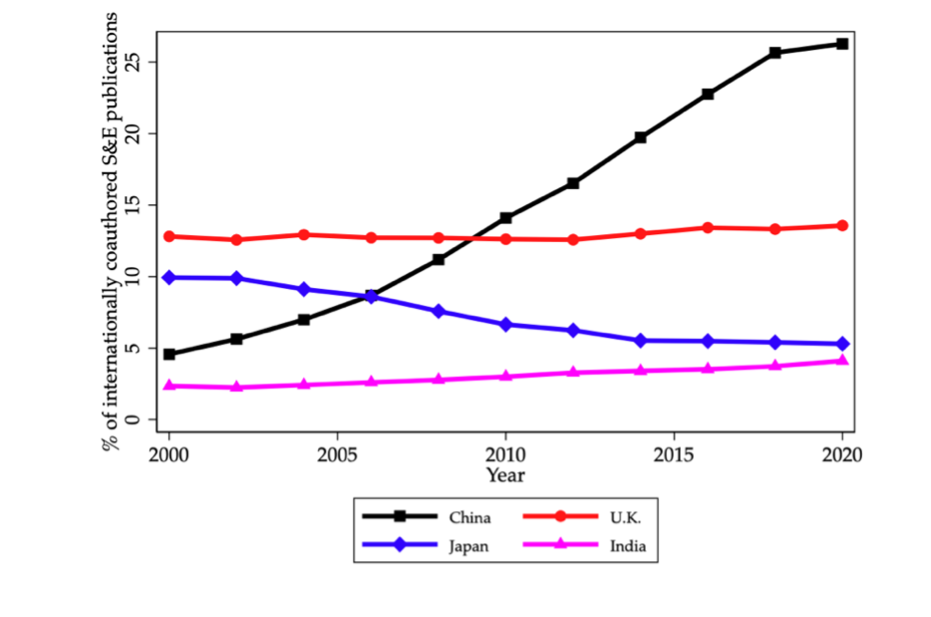
Figure 2. Share of Internationally Coauthored S&E Publications in the U.S.
At the enterprise level, Chinese businesses exposed to sanctions have demonstrated considerable resilience: despite moderate drops in profitability, these businesses have been found to produce more original innovations and maintain strong innovation performance. Moreover, the market value of Chinese companies in sanctioned sectors has not experienced a significant decline, possibly partly due to China's countermeasures against U.S. sanctions.
Economic and talent exchanges have driven the U.S. and Chinese technological systems toward increasing interconnectedness, making it difficult for unilateral restrictions from either side to reverse this market-driven trend. Our empirical research shows that policies promoting the integration of international technological systems (e.g., policies supporting strategic emerging industries) align with market forces and can effectively accelerate the integration of U.S. and Chinese technological systems. In contrast, policies aimed at artificially decoupling technological systems (e.g., unilateral sanctions) conflict with market forces and fail to achieve their intended objectives.
III. Spillover Effects of Sanctions in the Innovation Network Framework
In the innovation network framework, different industries are interwoven into an organic whole through close and deep knowledge connections and technology transfers. These connections create a complex and interdependent innovation network between the world’s two largest economies, the U.S. and China. This raises the question of whether the policy measures introduced above, when applied to a specific field, could transmit to other fields through the innovation network, potentially leading to unintended consequences and broader impacts than initially anticipated. To answer this question, we utilize an input-output table of innovation activities to depict the innovation network framework and examine the spillover effects of U.S. sanctions on the upstream and downstream sectors of the sanctioned fields in China.
Our empirical results show that U.S. sanctions have led to significant yet asymmetric spillover effects on both the upstream and downstream fields of the sanctioned industries in China through the innovation network. For downstream industries, the business performance of enterprises has suffered, but these industries have accelerated their integration into the international technological system. In contrast, for upstream industries of the sanctioned field, sanctions have led to decoupling from the international technological system, but the enterprises' business performance has improved.
For example, when the Chinese semiconductor industry is subject to U.S. sanctions, downstream industries, such as smartphone manufacturers, experience negative economic impacts due to the sanctions on domestic suppliers. However, this prompts Chinese smartphone manufacturers to turn to foreign suppliers, accelerating their integration into the international technological system. Conversely, sanctions on the Chinese semiconductor industry lead Chinese semiconductor producers to rely more on domestic semiconductor design firms (upstream industries), improving the economic performance of upstream enterprises. However, this shift in demand creates a protected innovation environment isolated from international competition for the upstream suppliers, leading to their decoupling from the international technological system.
These findings suggest an inherent contradiction between the two main policy goals of economic and technological sanctions: curbing the development of targeted enterprises and accelerating their decoupling from the international technological system. Although these goals appear compatible, the spillover effects of sanctions on upstream and downstream industries create an inevitable trade-off between their two policy objectives: if sanctions target relatively downstream industries, the spillover effects can lead to their upstream industries' decoupling from the international technological system, accompanied by an improvement in business performance. Conversely, sanctions targeting relatively upstream industries harm downstream enterprises' performance but accelerate their integration into the international technological system, thus failing to achieve decoupling.
Therefore, our analysis shows that economic sanctions, such as those imposed through the entity list, may not be able to precisely target their intended objectives or achieve their policy goals due to the spillover mechanisms within the innovation framework. Sometimes, even mild restrictions can lead to chaotic and uncontrollable decoupling, which not only fails to achieve the policy goals but also can potentially lead to market disorder and instability beyond intention.
IV. Policy Recommendations
U.S. sanctions against China arise from the evolving international geopolitical landscape and are expected to persist and intensify, likely extending from military to civil and commercial technologies. It would be unrealistic to rely on changes in domestic political forces in the United States to lift such sanctions.
However, despite widespread attention and even sensationalism surrounding U.S. sanctions against China, our empirical findings show that these sanctions may not be able to precisely target their intended objectives or effectively achieve their policy goals. U.S. sanctions have not led to significant U.S.-China technology decoupling, and Chinese enterprises in sanctioned fields have demonstrated notable resilience, as evidenced by their increasingly original and explorative R&D activities, despite experiencing moderate declines in business performance. Therefore, given the inevitable trade-off between the sanctions' performance-curbing and decoupling-promoting goals, it may be wise for China to neither underestimate nor overly worry about the impact of sanctions, and instead focus on developing its own technological strength at a sustainable pace.
Given the spillover effects of economic sanctions on both upstream and downstream sectors of the sanctioned field due to the interconnectedness of the innovation network, the spillover impact of such measures (and the asymmetry thereof) on upstream and downstream industries should be carefully considered when enacting industrial policies.
The effectiveness of industrial policy depends on the market's response. Given the market-driven trend of technology integration, policies aligning with this trend and promoting the integration of international technological systems can effectively accelerate the integration of these systems. In contrast, policies in conflict with this trend, such as those aimed at artificially decoupling technological systems, are unlikely to be effective.
* Originally published as: Han, Jiang and Mei, 2024. Mapping U.S.–China Technology Decoupling: Policies, Innovation, and Firm Performance. Management Science.
[1] Dr Pengfei Han is an Associate Professor of Finance at the Guanghua School of Management, Peking University.




